QUANTITATIVE RESEARCH / SCIENTIFIC COMPUTING

Portrait of Tianhao Le

Hi, I'm

Tianhao Le

Quantitative research,
physics & machine learning.

I’m a Quantitative Modeler and Vice President at Morgan Stanley. I build statistical and machine-learning models, drawing on research in atmospheric physics and scientific computing.

I earned my Ph.D. in Environmental Science and Engineering at Caltech (2022), with a minor in Computational Science and Engineering. Before that, I studied physics and applied mathematics at Peking University.

WORKING WITHPythonC / C++CUDAFortran

Away from research, I enjoy photography.

Light interacting with an atmosphereA conceptual line drawing of incoming light scattering through layered atmosphere above a curved planetary surface. FIG. 01LIGHT × MATTER incident lightscatteringθatmospheresurfacen̂
RADIATIVE TRANSFER / CONCEPT SKETCH
Weather forecasting, a conceptual sketchIllustrative weather contours and a forecast path through three abstract time steps. t₀t+1t+2forecast path weather field
WEATHER FORECASTING / CONCEPT SKETCH

01 / RESEARCH

Research directions.

METHODS → OBSERVATIONS → SYSTEMS

My research spans the numerical methods used to simulate radiation, the observations used to test them, and the atmospheric processes they help explain—from air quality on Earth to the energy budgets of giant planets.

I.

RADIATIVE TRANSFER

How much physics can a fast radiation model retain?

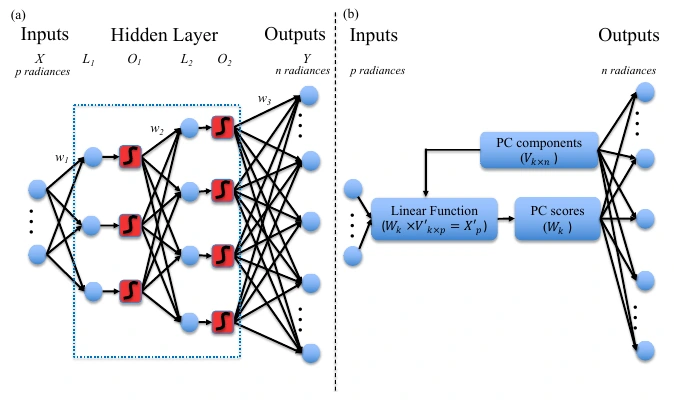
Neural spectral reconstruction cuts the cost of high-resolution radiative transfer.

In tested cases, NNRT achieved 100–1,000× speedups; errors were generally below 0.5% of peak spectral radiance. Related studies use principal-component compression (SDCOMP) and a two-stream treatment with exact single scattering (2S-ESS) to examine other accuracy–cost trade-offs.
II.

SATELLITE OBSERVATIONS

What can satellite spectra reveal about clouds and dust?

Cloud overlap and dust-layer structure leave measurable signatures in satellite spectra.

OCO-2 oxygen A-band observations constrain coastal dust optical depth and layer height. AIRS spectra test cloud-overlap assumptions over non-frozen oceans, using brightness-temperature distributions and the first Wasserstein distance to assess agreement beyond correlation.

III.

AIR QUALITY & CLIMATE

How do emissions affect air quality and climate?

Lower emissions do not always translate into cleaner air or a simple climate response.

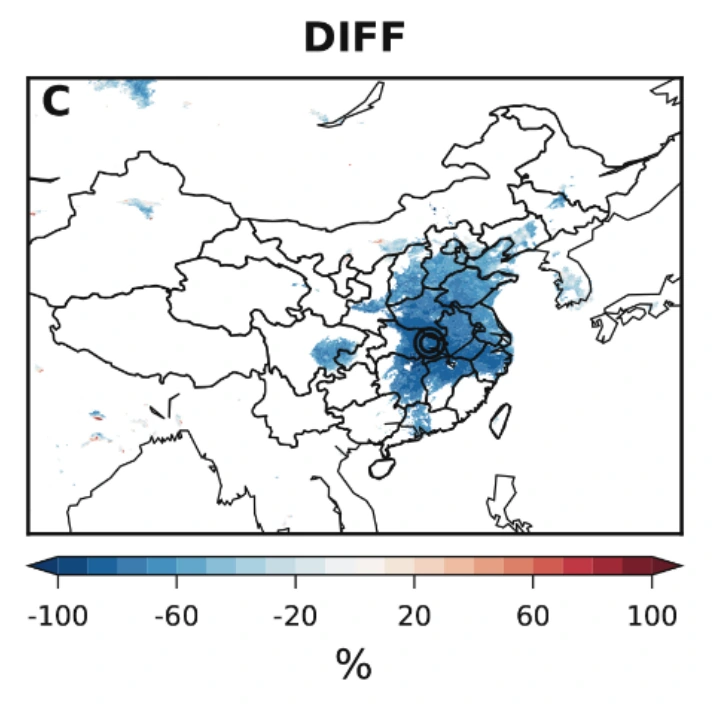
Studies of China’s lockdown haze examine interactions among emissions, chemistry and meteorology. Regional simulations separate local pollution from transport; longer-term experiments connect European aerosol reductions to the jet stream and northern Eurasian winter extremes.

IV.

PLANETARY ATMOSPHERES

How do atmospheres regulate planetary energy flow?

Horizontal atmospheric structure can change a planet’s interior cooling.

HARP calculates radiation budgets in giant-planet atmospheres. Jupiter simulations examine how gases, polar haze and mechanical forcing shape temperature and circulation; hot-Jupiter simulations test how spatial variations in temperature and opacity alter heat loss relative to uniform models.

02 / PUBLICATIONS

Selected publications.

First- and second-author papers, selected by citation count.

View all 11 papers

Citation counts: OpenAlex · checked 31 October 2026.

03 / CONTACT

Get in touch.